Eye Drops or Nighttime Ointment? What's the Difference and When to Use Each
Lubricating eye drops are light and quick, so they suit the daytime. Ointments are thicker and blur your vision for a while, so they are usually saved for bedtime. Here is how the two differ and how to choose.
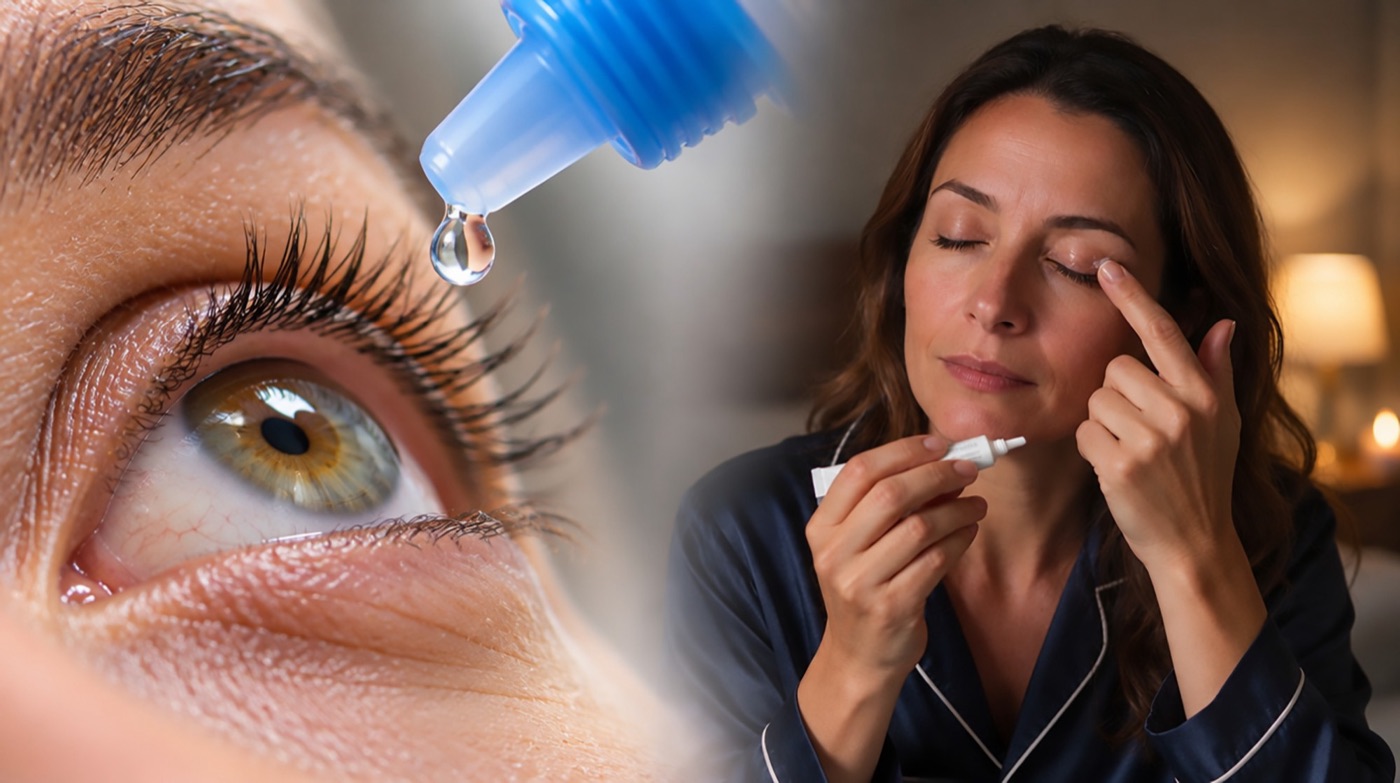
Lubricating eye drops and eye ointments do the same basic job, adding moisture to the surface of your eyes, but they work on different schedules. Drops are thin and clear, so you can use them during the day and keep reading, working or driving. Ointments are much thicker. They stay on the eye longer, but they blur your vision for a while, so most people use them at bedtime. Eye doctors often suggest liquid drops for the day and gels or ointments at night [1]. If you find yourself reaching for drops several times a day, it is a good time to see an eye doctor.
What eye drops and ointments have in common
Both are over-the-counter eye lubricants, sometimes called artificial tears. They add moisture to the tear film, the thin layer of liquid that covers the front of your eye. Lubricants are one of the first steps eye care experts suggest for everyday eye dryness [2].
The big difference is thickness. From thinnest to thickest, there are three main types [1]:
- Liquid drops, which feel light and clear quickly.
- Gel drops, which are thicker and stay a little longer.
- Ointments, which are the thickest and come in a small tube instead of a bottle.
As one simple rule from the American Academy of Ophthalmology puts it, the thicker the lubricant, the longer it tends to last on the eye, and the more it tends to blur your vision afterwards [1].
Eye drops: made for the daytime
Liquid drops are easy to use on the go. You can put them in at your desk, after a long meeting or before a drive, and your vision is usually clear again within a moment or two.
Preservatives: when they matter
Many drops in multi-use bottles contain a preservative that helps keep germs out once the bottle is open [3]. If you only use drops now and then, a preserved drop is usually fine. But if you use drops more than four times a day for a long time, eye doctors suggest choosing a preservative-free drop [1]. Some preservatives can irritate the surface of the eye when they are used often and for a long time [4].
Drops to be careful with
Not every eye drop is a lubricant. Drops sold to "get the red out" often contain ingredients that shrink blood vessels, such as tetrahydrozoline or naphazoline. The AAO advises being careful with these, because they can make redness and discomfort worse over time [1]. Read the label and look for drops sold for dry or tired eyes.
Ointments: made for the night
While you sleep, your eyes are closed and you are not blinking, but some people still wake up with eyes that feel dry, gritty or stuck. A thicker lubricant at bedtime stays on the eye through the night, when blurry vision doesn't matter.
Because ointments blur your vision, use them as the last step before you turn off the light, after you have finished reading or using your phone. Don't use them before driving or any task where you need clear vision [1].
How to use them safely
- Wash your hands with soap and water first.
- Don't let the tip touch anything, including your eye, your fingers or your clothes. This helps keep the drops or ointment clean [3].
- Follow the directions on the package, including how often to use it and how long it is good for after opening.
- Wait a few minutes between products if you use more than one, and use the thickest one last.
- Remove contact lenses before using a product that isn't made for use with lenses, unless your eye care provider tells you otherwise.
- Stop and call your doctor if you notice pain, discharge, vision changes or discomfort [3].
- Check for recalls. The FDA keeps a list of eye drop recalls and warnings, and the AAO suggests avoiding any drop on that list [1, 3].
See an eye doctor if you have eye pain, changes in your vision, a lot of redness, or dryness that gets worse or doesn't go away. Dry eyes can have many causes, and an eye exam is the best way to find out what is behind yours and which products are right for you.
Drops or ointment: a simple way to choose
- Your eyes feel dry during the day: start with liquid drops. Choose preservative-free if you use them often.
- Your eyes feel dry first thing in the morning: ask your eye doctor whether a bedtime gel or ointment makes sense for you.
- You need drops more than two or three times a day: see an eye doctor for a full exam [1].
- Not sure what kind of dry eye you have: an eye doctor can tell you, and the answer can change which lubricant works best [1].
How EYELIVIO fits in
Many people pair their evening eye care with a few minutes of soothing warmth before bed. EYELIVIO Self-Warming Eye Masks make that easy:
- No microwave and nothing to plug in. The mask starts warming on its own about 30 seconds after you open the pouch.
- Up to about 20 minutes of gentle, soothing warmth, enough for a 10–15 minute rest.
- Individually wrapped with soft ear loops, so one is always ready on your nightstand.
Open a pouch, wait about 30 seconds, hook the loops behind your ears with your eyes closed, and relax for 10–15 minutes. Then remove and discard the mask. Use the mask while you are awake and relaxing, and if your eye doctor has recommended a bedtime drop or ointment, follow their directions for it.
Start with the Self-Warming Eye Masks · 10 Pack. For a full evening routine, read Your 15-Minute Bedtime Routine for Dry, Tired Eyes and Heat's On, Eyes Dry?
Quick answers
What is the difference between eye drops and eye ointment? Both add moisture to the eye. Drops are thin and clear quickly, so they suit the daytime. Ointments are thick, last longer and blur your vision, so they are usually used at bedtime.
Why do eye ointments make my vision blurry? They are thick, so they spread a layer over the eye that takes a while to thin out. That is why they are usually the last thing you use before sleep.
Can I use eye drops during the day and an ointment at night? Many people do, and eye doctors often suggest this kind of routine [1]. Follow the directions on each package, and ask your eye doctor what is right for you.
Are preservative-free eye drops better? If you use drops more than four times a day for a long time, eye doctors suggest preservative-free drops [1].
When should I see an eye doctor about dry eyes? If you need drops more than two or three times a day, or you have pain, vision changes or a lot of redness, see an eye doctor [1].
This article is for general information only and is not medical advice. EYELIVIO self-warming masks are personal care products and are not intended to diagnose, treat, cure or prevent any disease. Always read and follow the label of any eye drop or ointment, and talk to your eye doctor about your symptoms.
Sources
- Mukamal R. Choosing the Best Lubricant Eye Drops for Dry Eyes. American Academy of Ophthalmology, EyeSmart. Published February 17, 2024. https://www.aao.org/eye-health/diseases/how-to-choose-lubricant-drops-dry-eyes
- Jones L, Downie LE, Korb D, et al. TFOS DEWS II Management and Therapy Report. Ocul Surf. 2017;15(3):575–628. doi:10.1016/j.jtos.2017.05.006
- U.S. Food and Drug Administration. What You Should Know about Eye Drops. Content current as of October 16, 2026. https://www.fda.gov/drugs/buying-using-medicine-safely/what-you-should-know-about-eye-drops
- Baudouin C, Labbé A, Liang H, Pauly A, Brignole-Baudouin F. Preservatives in eyedrops: the good, the bad and the ugly. Prog Retin Eye Res. 2010;29(4):312–334. doi:10.1016/j.preteyeres.2010.03.001
This article is for general information only and is not medical advice. Talk to your eye doctor about your symptoms and before starting any new routine.